What happens when the first son of the United States falls in love with a British prince? A poorly paced movie adaptation.
Amazon’s Red, White and Royal Blue fails to capture what made Casey McQuiston’s book captivating in the first place. The movie, which released on August 11, sacrifices depth and substance for the usual rom-com antics that are entirely overplayed and essentially useless for a story as riveting as McQuiston’s.
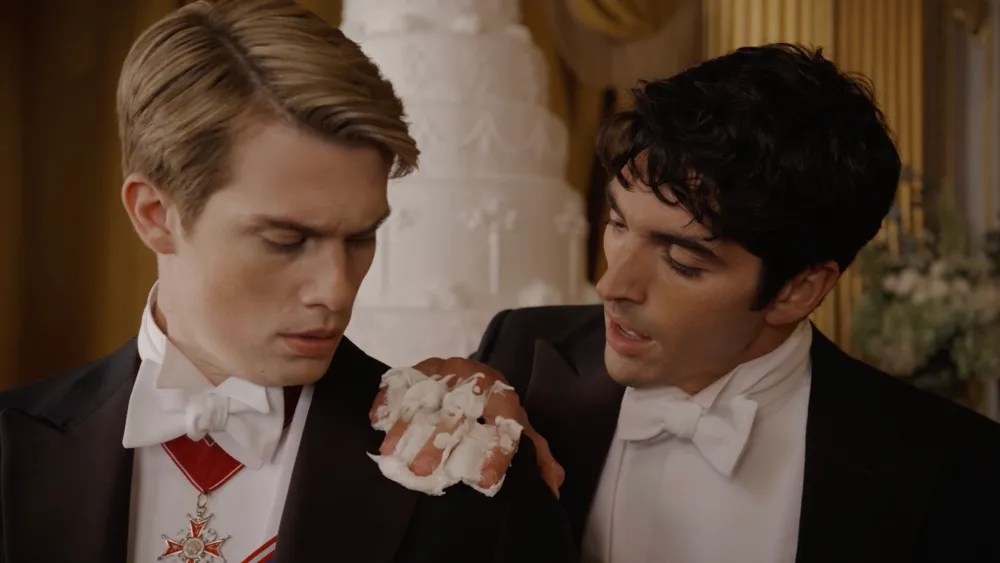
Alex Claremont-Diaz, played by Taylor Zakhar Perez, and Prince Henry, played by Nicholas Galitzine, strike up a romantic relationship and partake in clandestine meetings after they are forced by their teams to have a PR friendship in order to damage control for an incident they caused at Prince Philip’s wedding.
Unexpected and exciting, the two’s positions of power in their respective countries make it virtually impossible for them to love one another freely without scrutiny. Perez and Galitzine’s chemistry speaks for itself on the screen, bringing their characters to life in a way that represents the hardships that come with identity.
However, while their relationship is as every bit exciting and emotionally charged as it is in the book, the characters lack any sort of depth.
In the movie, Alex’s mental health issues and LGBTQIA+ journey is completely erased in favor of his love for Henry. While this change may seem insignificant, it takes away from the struggles his character actually faced throughout the book and makes him seem very two-dimensional.
Henry’s story is kept, but poorly explained. While the audience is aware of his father’s death, it’s unclear how deeply this affects him and his ability to be open and vulnerable with Alex.
Perhaps Matthew Lopez and Ted Malawer thought that any aspect of the film that didn’t entirely revolve around Henry and Alex’s relationship would be received poorly by the audience. Unfortunately, the lack thereof hurts the film’s ability to provide characters that are more than just their significant other.
While some of the changes from book to screen are to the film’s detriment, Alex’s political journey and involvement in Texas’s polling is a change that positively affected his character. It allowed the audience to see his compassion for his home state and his belief that if you have a platform, you should use it for change.
Another highlight of the film was Zahra, played by Sarah Shahi, who completely stole every scene she was in. Shahi perfectly embodies the character’s witty aggressiveness and comedically navigates the insanity of working with a First Family as dysfunctional as the Claremont-Diazs.
Unfortunately, the same cannot be said for Uma Thurman, who plays President Ellen Claremont. Her acting was stale and the Southern accent she attempted only made her scenes hard to watch.
As a whole, the film provides a cute love story with a Romeo and Juliet forbidden type of romance, but it fails to actually make the viewers understand the characters on a level deeper than appearances and romantic love. If I wanted a surface-level feel good rom-com, I would’ve just watched an Adam Sandler movie.
 that one girl who reviews
Leave a comment